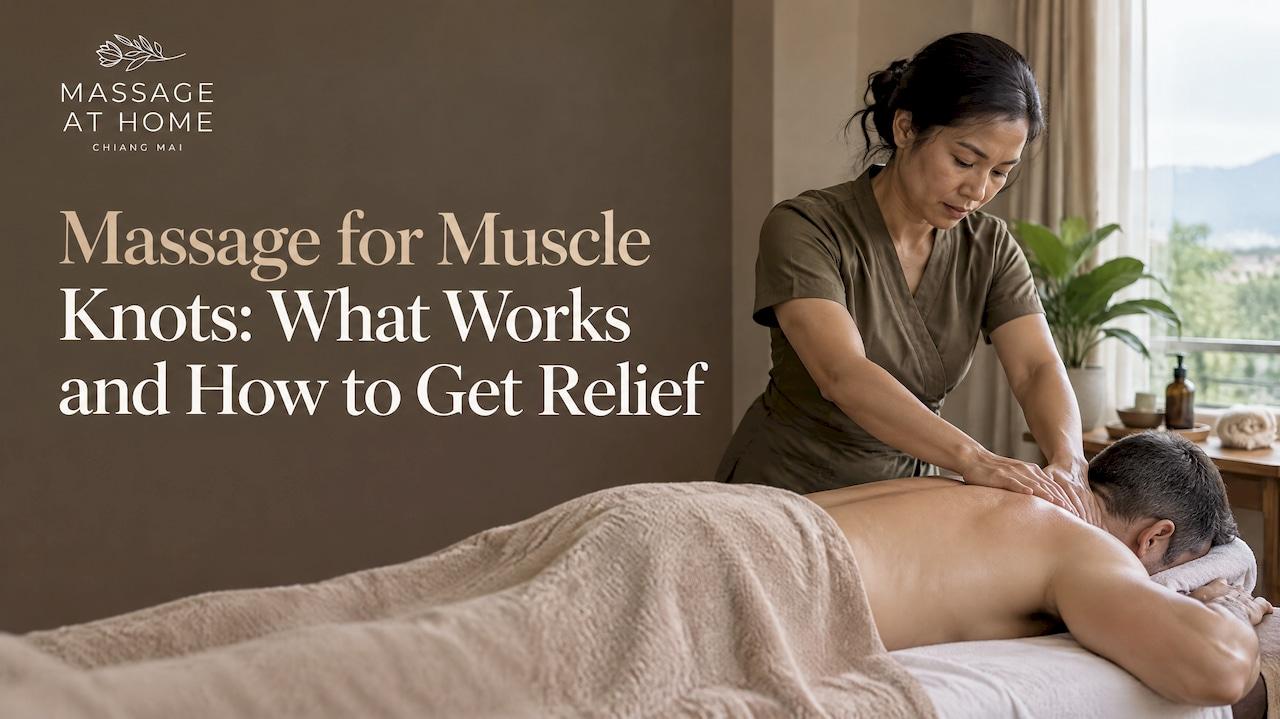
A muscle knot is a small, tight, tender spot in a muscle, and massage is one of the most direct ways to ease it. A therapist works the area with steady, controlled pressure while you lie down and do nothing, which is hard to match when you are pressing on your own sore shoulder. In Chiang Mai you can have that done in your condo, house or hotel room: our DHSS-licensed therapists come to you every day, and you can book in English or Thai by messaging or phone.
This guide explains what a knot is, what kind of massage suits it, what to do between sessions, and when the pain needs a doctor instead.
TL;DR
- A muscle knot is a myofascial trigger point: a small patch of tightly clenched muscle fibers, most common in the neck, shoulders and back.
- Massage relaxes the tight tissue and encourages blood flow. Thai, deep-tissue and oil massage each approach knots differently, so choose by the type of pressure you like.
- Between visits, 30 to 90 seconds of steady thumb or tennis-ball pressure and gentle stretching can keep the area loose. Self-massage should never be sharply painful.
- Pain that persists, or comes with swelling, heat, redness or drainage, needs a health professional.
- Home visits in Chiang Mai cost 699-1,199 THB for Thai massage and 899-1,399 THB for oil or deep-tissue work, plus a 100-300 THB travel charge in some areas.
Table of Contents
- What a muscle knot actually is
- What massage does for a knot
- Which massage suits muscle knots
- Why a home visit suits knot relief
- How to release a muscle knot yourself between sessions
- Safety: when to be careful and when to see a doctor
- Book a massage for your knots in Chiang Mai
- FAQ
- Sources
What a muscle knot actually is
Cleveland Clinic describes a muscle knot as a myofascial trigger point: small, tightly clenched muscle fibers lying just under the skin. They show up most often in the neck, shoulders and back, the places that take the load of desk work, long scooter rides, carrying bags or sleeping in an awkward position.
In practice a knot feels like a small hard lump, sometimes compared to a marble, that hurts when pressed. It may also ache on its own, limit how far you can turn your head, or send a dull pain into a nearby area.
Are muscle knots painful?
Yes, usually. The spot is tender to the touch, and a knot in the upper trapezius (the muscle between neck and shoulder) can bring on stiffness that makes turning your head uncomfortable. Many knots, though, simply feel like tightness. Cleveland Clinic notes that most knots improve on their own over time, but they can hang around for weeks if the habit that caused them continues.
Why they form
Overuse, strain and repetitive movement are the usual causes. In Chiang Mai the common triggers we hear about from visitors and residents are easy to picture: hours bent over a laptop at a café, long motorbike rides up to Doi Suthep, a day of trekking with a heavy pack, or a flight followed by a thin hotel pillow.
What massage does for a knot
The aim of massage on a knot is to help the clenched tissue let go. UW Health clinical massage therapist Michael Johnson explains that pressing on a trigger point for 5 to 10 seconds and then releasing is thought to restore blood flow and help the overexcited muscle relax. He also describes how, in myofascial release theory, the connective tissue forms one system around and through each muscle, so a restriction in one place can affect muscles elsewhere. Trained therapists can find latent trigger points that are not tender until they are pressed.
That last point is a real advantage of having someone else do the work. When a knot sits between your shoulder blade and spine, you cannot reach it well, and you cannot relax the surrounding muscle while you are using it to push.
There is also research from Thailand itself. A 2015 systematic review of six studies found that traditional Thai massage reduced chronic pain by 25% to 80% from before to after treatment, with improvements in perceived muscle tension, flexibility and anxiety, and benefits that lasted up to 15 weeks in some studies. Results vary by person and condition, and a review of this kind covers chronic pain in general rather than knots alone, but it shows why Thai massage is a natural place to start.
Which massage suits muscle knots
The right style depends mostly on how much pressure you like and where the knot is. Here is how the options we offer compare.
| Massage | Pressure and feel | Good for | Price at home |
|---|---|---|---|
| Thai massage | Rhythmic pressing, stretching and compression, done in loose clothing without oil | Tight neck, back and hips, stiffness from sitting or travel | 699-1,199 THB |
| Oil massage | Long flowing strokes with oil, from gentle to firm | General tension, a knot you want eased gently, relaxation after a long day | 899-1,399 THB |
| Deep tissue or sports massage | Slow, firm pressure on specific tight areas | Stubborn knots, active people, post-trek or post-workout soreness | 899-1,399 THB |
| Jap Sen | Pressure along energy lines, firm and focused | Persistent tightness along the back, neck and legs | 899-1,399 THB |
Prices are the ones published on our services and prices page. A travel charge of 100-300 THB applies in some areas.
Thai massage: the all-round choice
Thai massage combines pressure along the body with stretching, so it works on the knot and the muscles around it together. The Thai evidence base reflects that: a 2023 Thai review in the Srinakharinwirot University Medical Bulletin assessed studies from 2009 to 2022 and found evidence supporting Thai massage for reducing pain and easing muscle stiffness. If this is your first time and you are not sure which to pick, Thai massage at home in Chiang Mai is the easiest starting point.
Deep tissue and sports massage: for firm, focused work
If your knots are old, large or sit in a muscle you use hard, such as the calves after a hike or the shoulders after weeks at a desk, slow firm pressure is what many people want. You can read more about this approach on our page for deep tissue massage at home in Chiang Mai, and about our sports massage for active clients. If you have just come down from a trail, the guide to massage at home after hiking covers what to ask for.
Harder is not always better. WebMD notes that overly aggressive trigger-point or deep-tissue work can irritate a knot and increase pain and restriction. Say "firm but comfortable" when you book, and speak up during the session if the pressure is more than you can breathe through. A good guide: the pain should feel like a "good hurt" that eases as the muscle lets go, never sharp.
Oil massage: gentle and soothing
Some people tense up when pressure is intense, which defeats the purpose. Long gliding strokes with light to medium pressure, plus stretching, are a gentle route to simple relief, as WebMD's source Gallucci suggests. Our oil massage at home is a comfortable choice for this, and the guide on choosing between Thai and oil massage helps you decide.
Myofascial release
Mayo Clinic describes myofascial release as using light hand pressure to find stiff trigger points, and says massage and stretching can loosen muscles and joints. It recommends a therapist specifically trained in the technique. Our page on myofascial release in Chiang Mai explains the service options.
Why a home visit suits knot relief
Knots are not fixed in one session by most people, and the muscle is at its most relaxed right after treatment. That favors being treated where you can stay put afterwards.
- No travel afterward. You do not ride a scooter or sit in a songthaew with a freshly loosened neck. You can shower, lie down or go to sleep.
- Quick to arrange. You book by messaging platform or phone, and our appointments are often available within 30 minutes.
- Licensed therapists. Our therapists are DHSS-licensed, and our booking help is in English and Thai, so you can explain exactly where it hurts.
- Every day. Appointments are available daily, which helps when a knot flares up on a Sunday evening or the day before a flight.
- Your own space. Condo, house, hotel room or event venue, whichever suits you.
If you are weighing a home visit against going to a shop, we compare them honestly in home massage or a massage shop in Chiang Mai.
How to explain your knot when you book
A clear description helps the therapist get to the right place quickly. Tell us:
- Where it is. "Right side of my neck, just above the shoulder blade" is better than "my back."
- How long you have had it. A knot from last night's sleeping position is different from one that has been there for months.
- What pressure you like. Light, medium or firm.
- What you have done recently. A hike, a long flight, a new gym routine or a week at a desk.
- Any injuries, surgery or medical conditions. See the safety section below.
How often to book
Cleveland Clinic's page on myofascial release therapy says that sessions typically last 15 to 50 minutes and that a clinician may recommend them every 1 to 3 days for weeks or months in some cases, with post-treatment soreness fading fairly quickly. For most people with everyday desk or travel knots, a single session followed by self-care is a reasonable start. Residents with ongoing tightness often choose a regular weekly visit, and our guide to weekly home massage in Hang Dong shows how that can work.
How to release a muscle knot yourself between sessions
A professional session does the heavy lifting. Between visits, a few minutes of self-care helps the area stay loose. The UMass Medical School self-massage guide says to use your fingertips, thumbs, fists, elbows or a tennis ball, apply direct pressure or small kneading strokes around, along and across the muscle fibers, and stop immediately at any sharp or ongoing discomfort.
Simple hand technique
Hinge Health's physical therapists give a clear routine for the knot itself:
- Find the knot. It often feels like a marble under the skin.
- Press firmly with a thumb or finger for 30 to 90 seconds while you breathe deeply.
- Repeat for 3 to 5 minutes in total.
- Keep the discomfort tolerable throughout.
UW Health's shorter version is 5 to 10 seconds of pressure, then release, repeated a few times. Either way, ease off if it hurts sharply.
Tennis ball for the back
For spots you cannot reach, such as between the shoulder blades, lie on your back on the floor with a tennis ball under the knot and let your body weight do the pressing. Pause on the tender spot and breathe.

Foam roller
MD Anderson's guidance on self-myofascial release with a foam roller is to roll slowly, stop at a tender spot and hold pressure for several seconds until it relaxes, then move the roller about two inches in each direction and repeat. It works well for calves, thighs and the upper back after a hike or a workout.
Massage gun
Cleveland Clinic's Dr. Dakkak advises using a massage gun on low speed with gentle pressure, in sessions of 10 to 20 seconds building to about a minute per area. Avoid bony areas such as the spine, and reduce speed or intensity if it is painful.
A Thai self-massage method with evidence
A 2015 randomized trial in Thailand tested self-massage with a traditional Wilai massage stick on upper-back trigger points. Volunteers did about 10 minutes of pressing, with pressure building gradually to mild pain and held 5 seconds per point, plus 2 minutes of stretching, once a day for 5 days. Their pain fell significantly more than in the group taking ibuprofen 400 mg three times a day. The authors explain this with the gate control theory: pressure on skin and muscle stimulates receptors that block pain signals at the spinal cord, while better circulation helps stiff muscle relax.

Two practical lessons: short, regular sessions beat one long punishing one, and you do not need to find the exact spot to get a benefit.
Stretch and keep moving
Stretching alongside pressure is recommended in several of the sources above. After a session, gentle neck and shoulder stretches, a walk and a glass of water are a sensible follow-up. Changing the habit that caused the knot matters too: raise your laptop, take a break from your phone, and vary your sleeping position.
Safety: when to be careful and when to see a doctor
Massage for knots is generally comfortable, but some situations call for a doctor's advice first. Hinge Health lists situations where trigger-point massage may not be appropriate: after recent surgery or injury, during illness, with blood thinners or cortisone use, and with osteoporosis, rheumatoid arthritis, advanced degenerative joint disease, blood clots or deep vein thrombosis, or advanced diabetes. If any of these apply, check with your doctor before booking and tell us when you book.
See a doctor if the pain persists. Cleveland Clinic recommends evaluation for persistent pain, redness or inflammation, a growth or swelling, heat, or drainage. A doctor may offer treatments such as trigger-point injections or dry needling. Numbness, weakness, pain after a fall or accident, or chest pain are also reasons to see a doctor promptly rather than book a massage.
After a deep session, some soreness is normal and usually fades fairly quickly. Drink water, rest, and stretch gently.
Book a massage for your knots in Chiang Mai
If you want the knot dealt with by a licensed therapist, we come to your home, condo, hotel or event venue. Thai massage starts at 699 THB and runs to 1,199 THB; oil, deep-tissue, sports and Jap Sen sessions are 899-1,399 THB; the travel charge in some areas is 100-300 THB. Booking is by messaging platform or phone, with help in English and Thai.

See the full menu and prices on our services and prices page, or start from the Chiang Mai Massage at Home homepage. If you are in the Old City or Nimman, we have pages on deep tissue massage in Nimman and in the Old City.
FAQ
Do massages loosen knots?
Massage relaxes the tight muscle and encourages blood flow, which is how most professionals describe its effect on knots. Many people feel the area soften during the session and move more freely afterwards. Pair it with stretching and good habits to keep the relief.
How long does it take for a muscle knot to go away?
Cleveland Clinic says most knots get better over time on their own, and massage can help the process along. A recent knot may ease in a few days, while an older one often needs a few sessions plus daily self-care. A 2015 review found Thai massage benefits lasting up to 15 weeks in some studies.
What is the best way to get knots out of the neck?
A firm but comfortable Thai or deep-tissue massage covering the neck, shoulders and upper back works on the surrounding muscles as well as the knot. Between sessions, press gently with your fingertips for 30 to 90 seconds and stretch slowly. Avoid forceful twisting of the neck.
Why do my muscles feel crunchy during a massage?
The crunchy sensation many people report is common when tight tissue is worked, and is not usually a cause for concern on its own. If it comes with sharp pain, tell your therapist right away so the pressure can be adjusted. Persistent or severe pain should be checked by a doctor.
Can I book a knot massage on the same day in Chiang Mai?
Yes. Appointments are available every day, and we can often arrive within 30 minutes. Message us the location of your knot, the pressure you prefer and your address or hotel, and we will arrange it.
Sources
- How To Get Rid of Muscle Knots, Cleveland Clinic
- Bringing release to 'knotty' muscles, UW Health
- The efficacy of traditional Thai massage for the treatment of chronic pain, PubMed
- Evidence review of Thai massage in health care, Srinakharinwirot University Medical Bulletin
- Muscle Knots: What They Are, Causes, Symptoms and Treatments, WebMD
- Myofascial release therapy, Mayo Clinic
- Myofascial Release Therapy, Cleveland Clinic
- Tips, Tools and Techniques: self-massage guide, UMass Medical School
- Massage Therapy for Trigger Points, Hinge Health
- How to perform self-myofascial release with a foam roller, MD Anderson
- Effects of traditional Thai self-massage using a Wilai massage stick, PMC